
Database System Structure
- Siddharth Sharma
- Mar 11, 2025
- 3 min read

A database system is a complex software system that provides an efficient and convenient environment for managing and retrieving data. The structure of a database system can be divided into several components, each serving a specific purpose. Below is a detailed explanation of the database system structure:
1. Database
The database is the core component of the system, where the actual data is stored.
It is a collection of interrelated data, organized in a structured format (e.g., tables, records, and fields).
The database is designed to support data persistence, meaning the data remains intact even after the system is shut down.
2. Database Management System (DBMS)
The DBMS is the software that interacts with the database, applications, and users to manage and manipulate the data.
It provides an interface for performing operations such as querying, updating, and managing the database.
Examples of DBMS include MySQL, Oracle, PostgreSQL, and MongoDB.
3. Components of a DBMS
The DBMS itself is composed of several key components:
a. Storage Manager
Manages the storage of data on disk.
Includes components like:
File Manager: Manages the allocation of disk space and data structures used to store information.
Buffer Manager: Handles data transfer between disk and main memory.
Authorization and Integrity Manager: Ensures data integrity and enforces access control.
b. Query Processor
Translates user queries into low-level instructions that the database can execute.
Includes components like:
DDL Interpreter: Processes Data Definition Language (DDL) statements to define the database schema.
DML Compiler: Converts Data Manipulation Language (DML) queries into an executable form.
Query Optimizer: Determines the most efficient way to execute a query.
c. Transaction Manager
Ensures the ACID properties (Atomicity, Consistency, Isolation, Durability) of transactions.
Manages concurrency control and recovery mechanisms.
d. Data Dictionary (Catalog)
Stores metadata about the database, such as schema definitions, constraints, and user permissions.

4. Users and Interfaces
Database systems are used by various types of users, each interacting with the system in different ways:
End Users: Interact with the database through applications or query interfaces.
Application Programmers: Develop applications that interact with the database using programming languages and APIs.
Database Administrators (DBAs): Manage and maintain the database system, ensuring its performance, security, and reliability.

5. Database System Architecture
The architecture of a database system defines how the system is organized and how its components interact. The most common architectures are:
a. Single-Tier Architecture
The database and application reside on the same machine.
Suitable for small, standalone applications.
b. Two-Tier Architecture
The database system is divided into two parts:
Client Tier: Handles the user interface and application logic.
Server Tier: Manages the database and processes queries.
Commonly used in client-server applications.
c. Three-Tier Architecture
The system is divided into three layers:
Presentation Tier: Handles the user interface.
Application Tier: Manages the business logic and application processing.
Database Tier: Stores and manages the data.
Provides better scalability and flexibility for large applications.

6. Data Models
A data model defines the logical structure of the database and how data is stored, organized, and manipulated.
Common data models include:
Relational Model: Data is organized into tables (relations) with rows and columns.
Hierarchical Model: Data is organized in a tree-like structure.
Network Model: Data is represented as a graph with nodes and edges.
Object-Oriented Model: Data is represented as objects, similar to object-oriented programming.
NoSQL Model: Used for unstructured or semi-structured data, such as document-based or key-value stores.

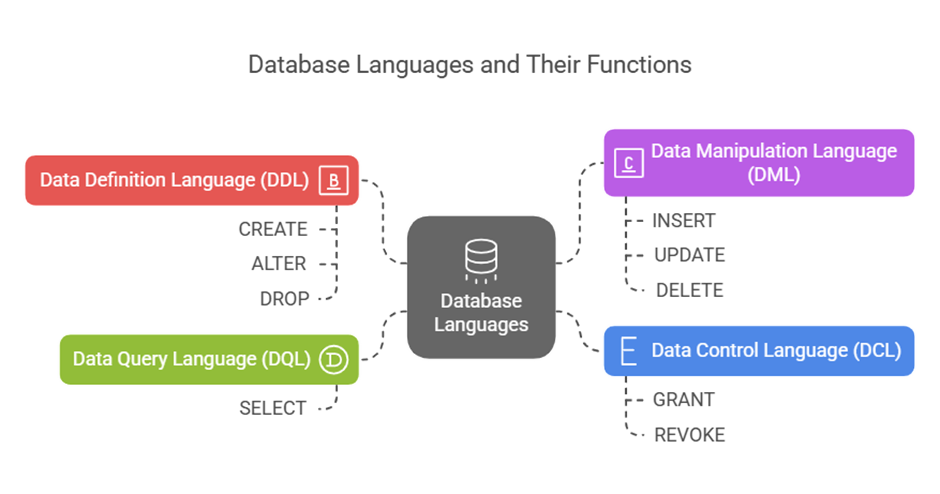
7. Database Languages
Database systems use specialized languages for defining, manipulating, and querying data:
Data Definition Language (DDL): Used to define the database schema (e.g., CREATE, ALTER, DROP).
Data Manipulation Language (DML): Used to manipulate data (e.g., INSERT, UPDATE, DELETE).
Data Query Language (DQL): Used to query data (e.g., SELECT).
Data Control Language (DCL): Used to control access to data (e.g., GRANT, REVOKE).
8. Storage and Indexing
Data in a database is stored on disk in files, which are managed by the storage manager.
Indexing is used to speed up data retrieval by creating data structures (e.g., B-trees, hash tables) that allow for faster searching.
9. Concurrency Control and Recovery
Concurrency Control: Ensures that multiple transactions can execute simultaneously without conflicting with each other. Techniques include locking and timestamp-based protocols.
Recovery: Ensures that the database can recover from failures (e.g., system crashes) and maintain data consistency. Techniques include logging and checkpoints.
10. Database System Applications
Database systems are used in a wide range of applications, including:
Banking and finance
E-commerce
Healthcare
Social media
Supply chain management
Summary
The structure of a database system is designed to provide efficient data storage, retrieval, and management. It consists of the database, DBMS, users, and various components that work together to ensure data integrity, security, and performance. Understanding the structure of a database system is essential for designing, implementing, and maintaining effective database solutions.


Comments