
Characteristics of Computers
- Siddharth Sharma
- Aug 13, 2025
- 3 min read

Updated: Aug 14, 2025
Computers are powerful electronic devices that have transformed every field of work. The effectiveness and popularity of computers are due to their unique and beneficial characteristics, which are outlined below:
🔹 1. Speed
Computers can process data and perform complex calculations at incredibly high speeds.
Operations that would take hours manually are done in milliseconds or microseconds.
Example: A modern computer can perform billions of instructions per second (BIPS).

Unit of Time:
Millisecond = 10⁻³ seconds
Microsecond = 10⁻⁶ seconds
Nanosecond = 10⁻⁹ seconds
🔹 2. Accuracy
Computers are highly accurate. Errors are mostly due to human mistakes (e.g., incorrect data entry).
If programmed correctly, they produce results with zero errors.
Used in fields like scientific research, engineering, and medical diagnostics for their precision.

🔹 3. Automation
Once a task is programmed, a computer can perform it automatically without further human intervention.
It follows predefined instructions (programs) to execute tasks from start to finish.
🔹 4. Versatility
A computer can perform a wide variety of tasks:
Word processing
Web browsing
Playing music/videos
Accounting
Scientific simulations
The same machine can be used for multiple purposes with the help of different software.

🔹 5. Diligence
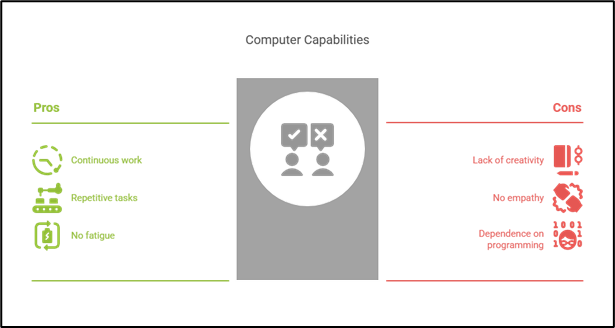
Unlike humans, computers do not suffer from fatigue or lack of concentration.
They can work continuously for long hours without any degradation in performance.
Ideal for repetitive tasks like data entry, monitoring, and calculations.
🔹 6. Storage Capability
Computers can store a large amount of data in a small physical space.
Data can be retrieved quickly and efficiently.
Storage is categorized into:
Primary Storage (RAM, Cache)
Secondary Storage (Hard Drives, SSDs)
Tertiary/Backup Storage (External drives, cloud)
Example: Thousands of books can be stored in a single USB drive.

🔹 7. Communication
Computers can connect and communicate with other systems and devices over networks (LAN, WAN, Internet).
Used for:
Emails
Video conferencing
Cloud computing
Social media

🔹 8. Multitasking
Modern computers can handle multiple tasks simultaneously.
Example:
Listening to music
Downloading files
Editing a document — all at the same time.

🔹 9. No Intelligence
Computers operate on the basis of instructions given to them.
They cannot think, reason, or make decisions on their own.
They follow logical and mathematical rules defined by programmers.
🔹 10. Lack of Feelings and Emotions
Computers do not have emotions, feelings, or instincts.
They do not get tired or bored — they are purely logical machines.
🔹 11. Scalability
Computers can be upgraded or expanded in terms of memory, processing power, and storage capacity.
Easy to adapt as per changing needs.
🔹 12. Reliability
Computers are reliable for long-term tasks like server management, control systems, or industrial automation.
Less likely to break down if maintained properly.
Summary Table:
Characteristic | Description |
Speed | Performs tasks in micro/nanoseconds |
Accuracy | High precision in output, minimal errors |
Automation | Works on predefined instructions automatically |
Versatility | Can perform various tasks using different software |
Diligence | Works nonstop without tiredness |
Storage Capability | Stores large volumes of data efficiently |
Communication | Connects and exchanges data with other devices |
Multitasking | Executes multiple tasks at the same time |
No Intelligence | Cannot think or make decisions independently |
Lack of Emotions | Does not feel boredom, tiredness, or emotions |
Scalability | Can be upgraded and customized as per requirement |
Reliability | Highly dependable for long and critical tasks |
📌 Conclusion:
The characteristics of computers make them indispensable in today’s world. From homes to industries, and from classrooms to research labs, computers continue to revolutionize our work and lives due to their speed, accuracy, storage, and automation capabilities.


Comments